A Deaf-Led Inclusive Music Workshop at Manchester Deaf Centre
Project Leader Noa Nishizawa

Noa Nishizawa is a Manchester-based professional brass musician and artistic researcher with profound bilateral hearing loss. She is currently completing a PhD at the University of Salford’s Leverhulme Aural Diversity Doctoral Research Hub (LAURA), exploring how visual communication can enhance musical experiences for Deaf and hard-of-hearing musicians in brass ensembles. Alongside performing internationally, Noa leads accessibility-focused projects including Can You See the Sound? and See the Sound, Play the Music!, supported by the RNCM Creative Innovator Award and Yamaha Entrepreneurship Award.
Project Manager Johanna Leung
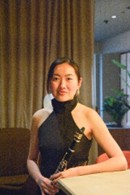
Johanna Leung is a Manchester-based Producer and Project Manager specialising in contemporary art and music project productions. She has led productions across Manchester, including the Arts Council England-funded multidisciplinary contemporary art festival Reimagined City Festival, productions with UnHeard, and the International CoMA Contemporary Music For All Festival (Manchester). Drawing on experience across the music, arts and cultural sectors, Johanna brings a collaborative and interdisciplinary approach to project delivery.
Johanna Leung is also an active clarinettist based in Manchester. She graduated with a Master of Performance from the Royal Northern College of Music in 2021.
Last month, Manchester Deaf Centre hosted See the Sound, Play the Music! — a Deaf-led inclusive music workshop created by musician and researcher Noa Nishizawa in collaboration with Manchester Deaf Centre.
The workshop explored new ways of experiencing and creating music beyond traditional listening, using visual communication, rhythm, movement, vibration, and group interaction. Designed specifically for Deaf and hard-of-hearing participants, the session welcomed adults with all levels of musical experience — including many who had never made music before.
The project was supported through the Royal Northern College of Music (RNCM) Creative Innovator Award 2025 and the Yamaha Entrepreneurship Award, helping to develop new accessible approaches to music-making for Deaf and hard-of-hearing communities.
Noa Nishizawa is a professional brass musician and a PhD researcher at the University of Salford as part of the Leverhulme Aural Diversity Doctoral Research Hub (LAURA). As a musician with profound hearing loss, her work explores how visual communication and embodied approaches can enhance musical experiences for Deaf and hard-of-hearing people, particularly within brass ensemble settings and music education.
Noa led the workshop through a series of visual and physical activities that encouraged participants to experience rhythm collectively and creatively.
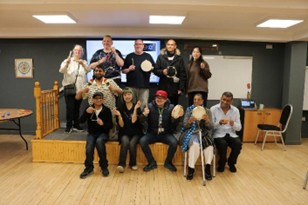
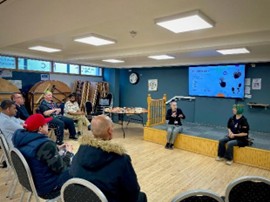
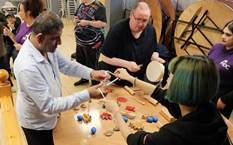
The first half of the workshop focused on body percussion and visual rhythm exercises, where participants explored pulse, coordination, and movement together as a group. Rather than relying only on hearing, rhythm was introduced through gesture, visual cues, physical movement, and shared timing.
In the second half, participants split into smaller groups and created their own short music performances using percussion instruments, visual symbols, colours, and collaborative decision-making. Participants then performed their pieces together in front of the group.
At the beginning of the session, some participants shared that they had previously struggled with music in school or had never felt included in music-making spaces. However, confidence and engagement grew throughout the workshop as participants found new ways to connect with rhythm and creativity.
Feedback from participants included:
- “I could feel the vibration through my heart.”
- “Really useful — the symbols and visuals were good.”
- “It was difficult at first, but I enjoyed it.”
- “Please do this again in the future.”
- “Everyone wants you back!”
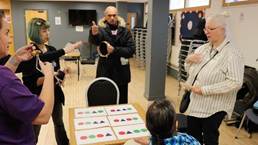
The workshop aimed not to simplify music, but to rethink how music can be accessed and experienced. By focusing on visual communication, vibration, movement, and shared interaction, the session demonstrated that music can be experienced in many different ways — not only through hearing.
Reflecting on the workshop, Noa shared:
“For a long time, music was something I was told was not for people like me because I am Deaf. Through this workshop, I wanted to create a space where people could experience music differently — visually, physically, and collectively. Seeing participants grow in confidence and enjoyment throughout the session was incredibly meaningful.”
The workshop was supported by Manchester Deaf Centre as part of its wellbeing programme and forms part of Noa’s wider accessibility-focused artistic research project exploring visual communication and inclusive approaches to music-making.
The success of the session has opened conversations about future workshops and continuing to create accessible music experiences for Deaf communities.
You can view a short video on the project here
Noa Kurumi Nishizawa, PhD Candidate, Student Representative of Royal Musical Association
k.nishizawa@edu.salford.ac.uk/ LAURA: The Leverhulme Trust Aural Diversity Doctoral Research Hub | University of Salford