Programme
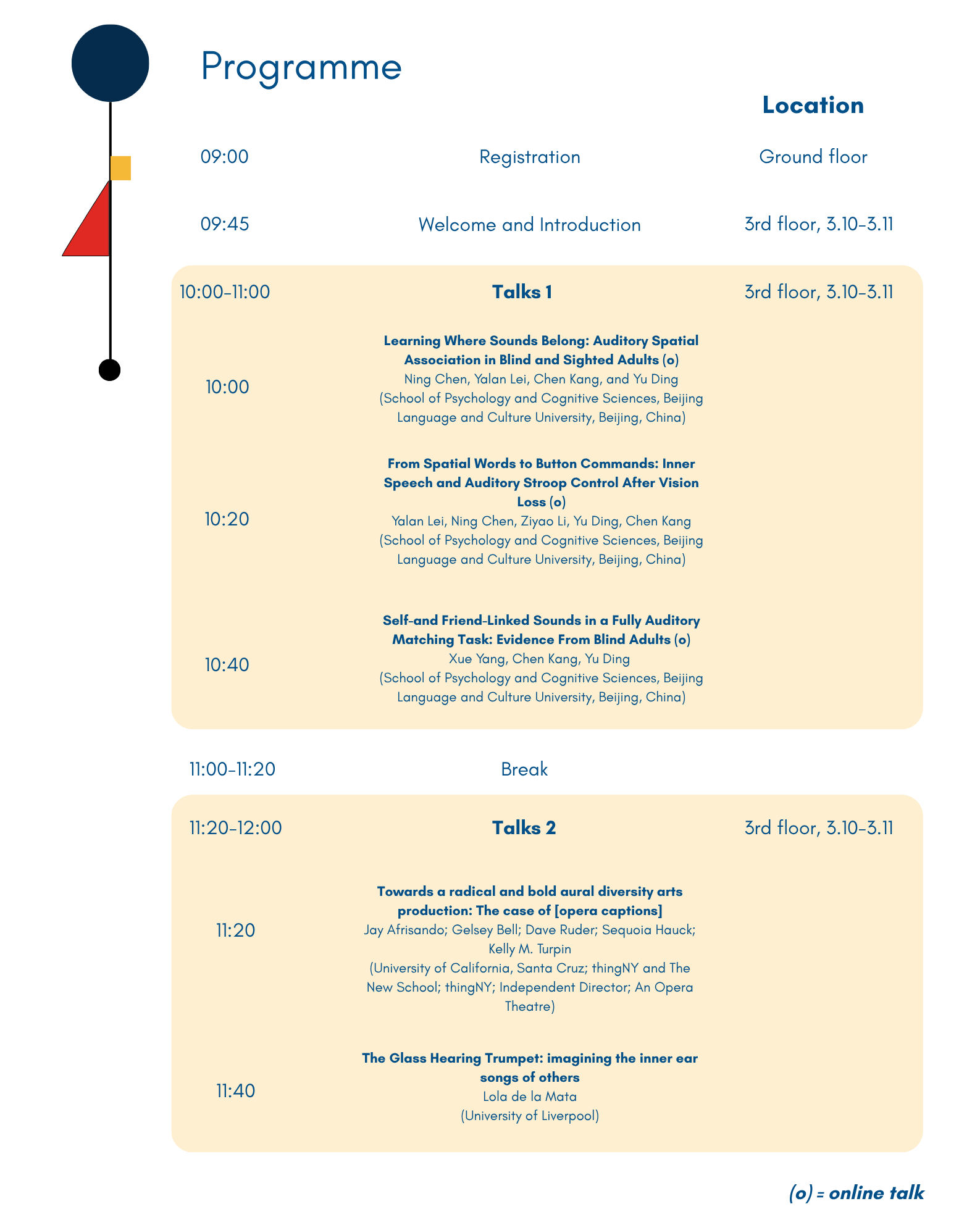
Abstracts
Talks 1
Learning Where Sounds Belong: Auditory Spatial Association in Visually Impaired and Sighted Adults
Ning Chen †, Yalan Lei †, Chen Kang*, and Yu Ding*
† These authors contributed equally and share first authorship.
* Corresponding author. (School of Psychology and Cognitive Sciences, Beijing Language and Culture University, Beijing, China)
Auditory spatial paired-associate learning (PAL) requires listeners to learn and retrieve associations between sound objects and spatial locations. Although long-term visual loss may increase reliance on auditory spatial information, it remains unclear whether people with visual impairment develop an advantage in learning sound-location associations. The present study therefore asked whether participants with visual impairment show better auditory spatial PAL performance than sighted participants. Twenty participants with visual impairment and 20 sighted controls completed a five-stage auditory spatial PAL task in which memory load increased from one to five sound-location associations. All participants first completed training with the spatialized sounds to ensure that they could identify the auditory locations before the formal memory task. Participants with visual impairment showed significantly better overall PAL performance than sighted controls. Their total first-attempt correct scores were higher (M = 8.25 vs. 5.85, Hedges’ g = 0.81, p = .013), and this group difference remained significant after covariate adjustment (standardized β = 0.79, p = .012). Participants with visual impairment also progressed through more PAL stages and made fewer errors relative to the number of sound-location associations introduced (1.74 vs. 2.71, adjusted p = .019). Together, these results indicate that participants with visual impairment were more efficient in learning and retaining auditory sound-location associations across increasing memory loads. These findings suggest that long-term visual impairment is associated with an advantage in auditory spatial associative learning, potentially reflecting greater reliance on auditory information for spatial representation.
From Spatial Words to Button Commands: Inner Speech and Auditory Stroop Control After Vision Loss.
Yalan Lei, Ning Chen, Ziyao Li, Yu Ding, Chen Kang (School of Psychology and Cognitive Sciences, Beijing Language and Culture University, Beijing, China):
Inner speech may support goal maintenance, action monitoring, and self-regulation. In blind listeners, externally heard spatial language may interact especially strongly with action codes because spatial information is often organized through auditory and linguistic channels. We tested whether changing simple spatial words into button-command phrases alters HRTF-based auditory Stroop interference, and whether this change relates to inner-speech style. Twenty blind adults and 18 sighted controls completed four spatialized auditory Stroop tasks. Simple-word tasks used spoken “left” or “right” and required either sound-location or speech-content judgments. Command tasks used phrases equivalent to “press the left/ right button” and again required location or content judgments. Participants also completed an inner-speech questionnaire and a temporal-fine-structure hearing measure. In simple-word conditions, blind participants showed a stronger asymmetry between location-focused and content-focused Stroop interference than sighted controls, F(1,35) = 4.71, p = .037; this group difference remained after controlling age and binaural TFS1 mean, F(1,34) = 6.04, p = .019. In blind adults, adding button-command wording changed the content-location interference structure, producing a significant planned command-effect contrast (M = -54.06 ms, p = .028) and a significant difference-in-differences effect (M = -52.18 ms, p =.034). This pattern was not observed in sighted controls. Evaluative inner speech correlated with the command-related content-task effect in blind adults (rho = .697, p = .001; FDR-adjusted p = .026), whereas TFS1 was not reliably related to command effects. Vision loss may change how auditory spatial words are integrated with action commands. Inner-speech style, rather than basic fine-structure hearing alone, may help explain individual differences in auditory semantic-action control.
Self-and Friend-Linked Sounds in a Fully Auditory Matching Task: Evidence From Visually Impaired and Sighted Participants
Xue Yang†, Yu Ding†, Chen Kang*
† These authors contributed equally and share first authorship.
* Corresponding author. (School of Psychology and Cognitive Sciences, Beijing Language and Culture University, Beijing, China):
Self-related stimuli usually receive perceptual and attentional priority, but most evidence comes from visual or audiovisual tasks. We asked whether visually impaired participants show auditory self-priority when all task information is delivered auditorily. Seventeen visually impaired participants and 16 sighted controls completed a fully auditory perceptual-matching task in which novel voices were associated with self, friend, or other identities. Participants judged match and mismatch trials; analyses examined reaction time, accuracy, and sensitivity (d prime), with age included as a covariate. Age-adjusted mixed models showed no reliable group by identity by trial-type interaction for reaction time or accuracy, but the group by identity interaction was significant for d prime, chi-square(2) = 10.12, p = .006. In matching trials, visually impaired participants responded faster to self- and friend-linked voices than to other-linked voices, whereas sighted controls showed a strong friend advantage. At the participant level, the reaction-time self-advantage index was significantly above zero in visually impaired participants, t(16) = 2.48, p = .025, but not in sighted controls. The d-prime self-advantage index was significantly higher in visually impaired than sighted participants (Welch p = .012, Hedges g = 0.92) and remained significant after age adjustment. Importantly, Rosenberg self-esteem was strongly associated with the reaction-time self-advantage in visually impaired participants (rho = .746, p = .001; age-adjusted partial rho = .742, p = .002), and also related to the d-prime self-advantage (rho = .546, p = .035). These findings suggest that visual impairment does not weaken auditory self-related processing. Instead, visually impaired participants may assign rapid priority to self- and familiar-social voices, with positive self-evaluation amplifying auditory self-priority.
Talks 2
Towards a radical and bold aural diversity arts production: The case of [opera captions]
Jay Afrisando; Gelsey Bell; Dave Ruder; Sequoia Hauck; Kelly M. Turpin
(University of California, Santa Cruz; thingNY and The New School; thingNY; Independent Director; An Opera Theatre)
Aural diversity arts have become increasingly ubiquitous, and their importance in raising awareness of aural diversity and bringing systems towards liberation and justice is undoubtedly crucial. However, little is known about how they impact arts production. Advancing aural diversity in the arts has consequences across all production levels, as such works penetrate and challenge current production systems and public expectations rooted in ‘normalcy’ in perception, understanding, creation, and sharing. This paper elucidates the making and production of the multifaceted performance [opera captions] that blends music, theater, film, poetry, and translation. It features captions as “actors,” inviting audiences to experience the reality and reimagination of captions and accessibility. The work was performed by New York composer-performers collective thingNY in 2023 and 2024, and, second, produced by St. Paul theater company An Opera Theatre in 2026. Both productions involved two different production and performance teams, funding, venues, and audiences, resulting in two different outputs. By sharing the motivations and processes behind both productions, this paper aims to enrich the scholarship of aural diversity arts productions. Therefore, by understanding what may implicate an artwork when aural diversity becomes its focus, artists and arts producers (broadly defined) can produce in a more rewarding collaboration, anticipate potential challenges, and adapt and improvise when any issues arise. [opera captions] presents a case that reveals and confirms the following points. First, an aural diversity arts project should take shape in a more flexible motivation, methodology, and form. Second, an aural diversity project can only be successful when its focus on aurally diverse listeners—and people—dismantles the ‘normal’ norm of making that still fosters expectations generated by the conventional arts disciplines. Thus, this paper calls for a wider set of stakeholders to imagine new ways of production that are people-conforming and methodologically bold.
The Glass Hearing Trumpet: imagining the inner ear songs of others
Lola de la Mata
(University of Liverpool)
‘The glass hearing trumpet’ is a site-specific installation for anechoic chamber, presented at Salford Acoustics Laboratory to small group audiences during Sound From the Other City Festival, May 3rd 2026. In preparation for this work, I collaborated with the National Organisation Tinnitus UK to collect descriptions of people’s tinnitus via an ethically approved survey which asked participants to describe the quality of the sound(s) they hear, and its rhythm or motion. Tinnitus (the experience of hearing sounds in one or both ears that others cannot), and the subject of aural diversity continue to be obscured by stigma in music industries. The challenge remains following a raise in public awareness over the terminology and experience of individuals living with tinnitus, resulting from its spotlight as a commonly recorded long-term symptom of covid. Affecting people differently, tinnitus can cause daily challenges, sometimes requiring medical intervention. My practice-research addresses the phenomenology of tinnitus, sitting outside of medical research. It takes as its starting point Johnathan Sterne’s view that ‘normalism’ of hearing is a persistent discourse which might be addressed by “hearing the hearing of others” and seeks to make a space in parallel where tinnitus is explored with curiosity and creatively. In offering a space in which to engage with tinnitus collectively, visibly, and through a creative lens, those with or without tinnitus are able to expand how they may feel about its power and role in an individual’s life. This work offers an additional view to experience tinnitus as an artefact we might want to archive, with unique songs we might listen to.
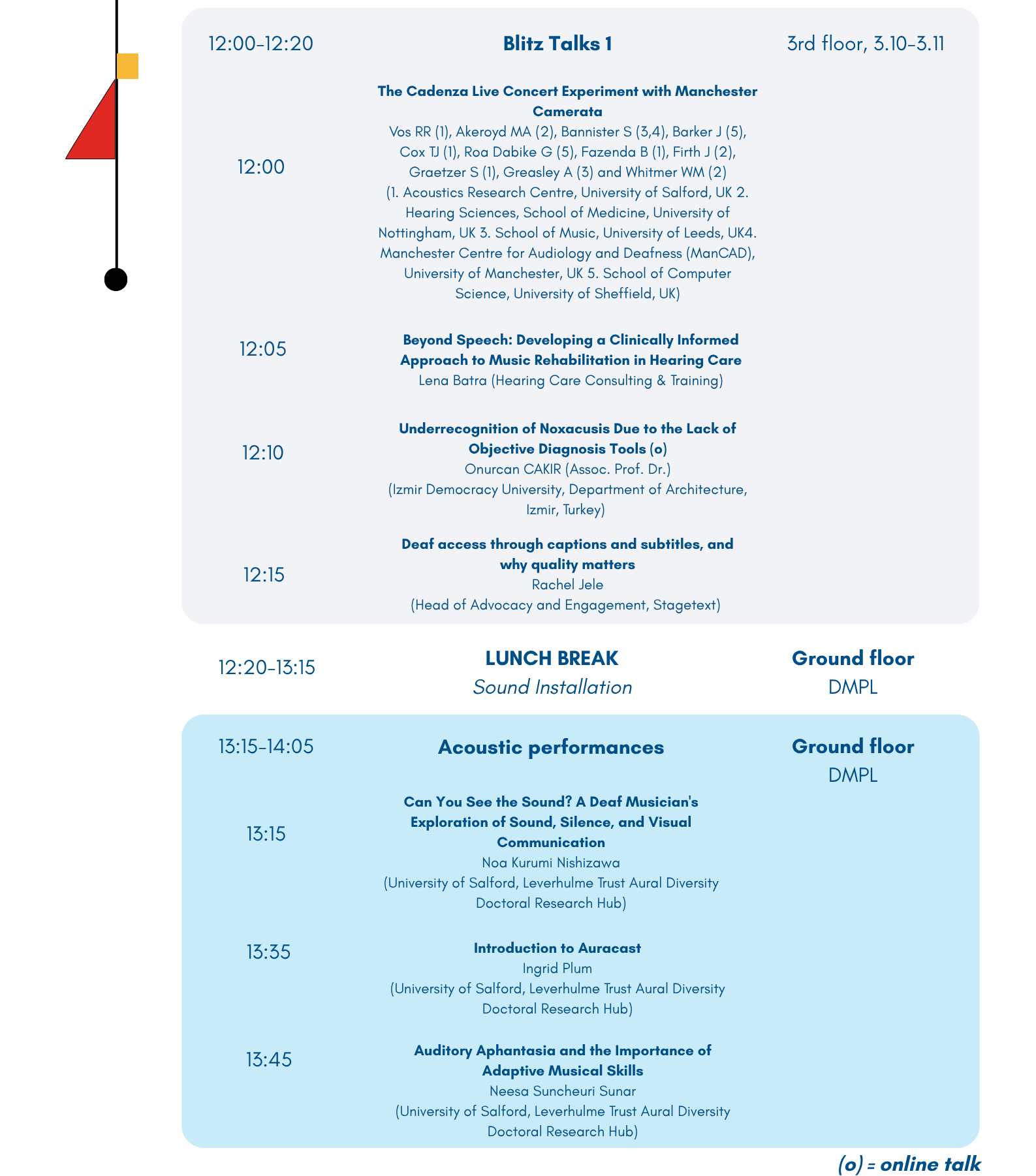
Blitz Talks 1:
The Cadenza Live Concert Experiment with Manchester Camerata
Vos RR (1), Akeroyd MA (2), Bannister S (3,4), Barker J (5), Cox TJ (1), Roa Dabike G (5), Fazenda B (1), Firth J (2), Graetzer S (1), Greasley A (3) and Whitmer WM (2)
(1. Acoustics Research Centre, University of Salford, UK 2. Hearing Sciences, School of Medicine, University of Nottingham, UK 3. School of Music, University of Leeds, UK4. Manchester Centre for Audiology and Deafness (ManCAD), University of Manchester, UK 5. School of Computer Science, University of Sheffield, UK)
Research on music listeners with hearing loss such as the “Hearing Aids for Music” (HAfM) project, has identified challenges including reduced dynamic range, distortion, and poor sound quality. However, few studies have examined these experiences in live orchestral settings. This study will announce the Cadenza Live Concert Experiment, a live-experience investigation of music perception in hearing aid users, conducted in collaboration with Manchester Camerata at Stoller Hall, at 3pm on Thursday, the 29th October, 2026. Participants with hearing loss will attend a live concert featuring Romantic repertoire (e.g., Beethoven Symphony No. 6) alongside a structured experimental component. During the performance, the orchestra will present controlled musical excerpts in which parameters such as dynamics and orchestral balance are systematically varied. Audience members will complete in-situ questionnaires capturing demographic and hearing-related information, alongside perceptual ratings of audio quality, loudness, clarity, and distortion. Open-ended responses will also be collected to document subjective listening issues during full movements. The study will aim to identify musical and acoustic conditions that contribute to degraded listening experiences for hearing aid users in real-world contexts. By integrating perceptual ratings with spatial data (seat location) and performance variables, the experiment will generate new insights into how hearing aid processing affects the live music listening experience. This work will demonstrate the value of concert-based research for capturing realistic listening experiences and advancing inclusive musical engagement and participation for listeners with hearing loss. Findings will inform the design of future studies and lead to improvements in hearing aid signal processing and fitting strategies for both live and recorded music, and improve accessibility of concert hall design.
Beyond Speech: Developing a Clinically Informed Approach to Music Rehabilitation in Hearing Care
Lena Batra
(Lena Batra® Hearing Care Consulting & Training)
Contemporary hearing care remains predominantly centred on speech perception and speech-based rehabilitation, despite the fundamental role that music plays in identity, emotional wellbeing, social connection, learning, culture and memory.As recognition of diverse listening experiences continues to grow, hearing care has historically lacked a clinically informed approach to understanding and supporting the music needs of people with hearing loss.
This presentation outlines the development of a clinically informed approach to music rehabilitation in hearing care, created through the integration of lived experience, current research, clinical expertise and application-based evidence. Developed in response to a recognised gap in professional education and clinical practice, the approach is operationalised through the PROM-T5 Care Framework®. It is delivered through the accredited professional education module, Hearing & Music in Hearing Care Practice: PROM-T5® Foundation Course, providing hearing care professionals with a structured approach to recognising and addressing the music needs of people with hearing loss. The PROM-T5 Care Framework® is now being adopted in clinical practice. The presentation will examine the clinical rationale underpinning this approach, including why individuals with similar audiometric profiles may experience music in markedly different ways, why conventional speech-focused rehabilitation often fails to capture these experiences, and the implications this has for person-centred hearing care. It will demonstrate how recognising music as a distinct dimension of rehabilitation can broaden clinical conversations, strengthen rehabilitation pathways and support wider health outcomes. By sharing the development and early implementation of this clinically informed approach, the presentation offers a practical contribution to current discussions surrounding diverse listening experiences, illustrating how research, lived experience and clinical expertise can be translated into meaningful innovation for contemporary hearing care.
Underrecognition of Noxacusis Due to the Lack of Objective Diagnosis Tools
Onurcan CAKIR (Assoc. Prof. Dr.)
(Izmir Democracy University, Department of Architecture, Izmir, Turkey.) onurcan.cakir@idu.edu.tr
Noxacusis (pain hyperacusis) is a rare condition in which everyday environmental sounds cause pain in affected patients. There is currently no established medical treatment or definitive cure for noxacusis. In severe cases, even the lowest-level sounds can become intolerable, potentially leading to an inability to leave the home and resulting in disability. In medicine, no objective diagnostic method for this condition has yet been established. Because it cannot be measured objectively, physicians may hesitate or refrain from making a diagnosis, leaving patients in a state of helplessness and forcing them to cope not only with pain but also with this social burden. Standard audiometric tests are often used as a first-line approach in clinical settings. However, it is known that amplified digital sounds during these tests can worsen patients’ symptoms and lead to setbacks. Moreover, in many cases where patients do not have hearing loss, audiometric testing becomes largely meaningless for establishing a diagnosis of noxacusis. Loudness Discomfort Level (LDL) tests may similarly cause either temporary or permanent setbacks. In addition, pain in noxacusis is often not immediate but delayed. In other words, the effect of a sound may occur as pain the following day.
This further complicates the objective measurement of the condition. Imaging methods such as MRI and CT scans, which are sometimes requested by physicians to exclude other conditions, may also harm patients due to the noise they generate; therefore, caution must be paid to avoid medical malpractice. Patients who are sometimes unable even to leave their homes are expected to attend hospitals and undergo sound-based testing, which, regardless of whether the results are positive or negative, does not meaningfully document the condition. Questionnaires such as the Hyperacusis Questionnaire (HQ) currently rely on patient self-report and are therefore subjective rather than objective. In ongoing research, an assessment approach has been proposed in which patients are exposed to sounds while pupillary responses are measured with pupillometry. Although this is an innovative design, the use of headphones and sound exposure may still pose a potential barrier for patients. As for future directions; a cochleoscope for clinical imaging of the inner ear is a promising device for objective diagnosis of noxacusis. Also, EEG-based pain assessment and the use of functional near-infrared spectroscopy (fNIRS) may offer potential. To capture delayed pain responses, post-stimulus monitoring would also be necessary.
Deaf access through captions and subtitles, and why quality matters
Rachel Jele
(Head of Advocacy and Engagement, Stagetext)
Everyone should be able to enjoy the theatre and the arts. At Stagetext, we believe in equal access for the whole audience, which is why we advocate for text-based deaf access in the form of captions and subtitles, for the 18 million adults in the UK who are deaf, deafened and hard of hearing.
Stagetext was founded by three deaf friends, and the charity remains deaf-led. Over 25 years we have enabled thousands of people to access and enjoy arts and culture through captions and subtitles.
Theatre captions look similar to subtitles on TV or film but displayed on large screens at the front of the theatre to ensure deaf, deafened and hard of hearing audiences can enjoy the show alongside everyone else.
Our research shows that 85% of deaf, deafened or hard of hearing respondents say that the quality of subtitles is important to them – and 63% of people questioned said that subtitles need to be as close to perfect as possible to be able to access what is being said. Quality matters.
In this presentation, Rachel Jele will talk about how quality captions and subtitles are essential for accessibility. She will describe her and others’ lived experience of deafness and how the effort and fatigue of trying to follow performances through lipreading, sound, speech, body language, and facial expressions causes cognitive overload and mental fatigue. Captioning changes that.
Sound Installation
Garden Ornament
Chrystal Cherniwchan (University of Salford)

‘Garden Ornament’ is an audio/visual piece with a running time of 4 min 28 sec, recorded at Prospect Cottage in Dungeness. This work is connected to my research around Derek Jarman and his blindness, his home that can be considered a sonic dwelling, and Aural Diversity.
Derek Jarman’s later work has frequently been discussed through the lenses of illness, AIDS, advocacy, landscape, queer theory and visual culture. Yet comparatively little attention has been paid to listening as a central creative practice within his work or to the role of Prospect Cottage as a sonic environment that shaped his artistic imagination. I’m interested in how Jarman’s experience of blindness offers an opportunity not simply to reconsider his later practice, but to rethink how artistic knowledge emerges through listening.
My practice-led PhD research proposes that aural diversity can be used as a framework for understanding listening as embodied, relational, and environmentally situated. Rather than treating blindness as a loss of vision, the research examines how changing sensory experience may have transformed Jarman’s relationship with sound, place and artistic practice. Prospect Cottage is approached not simply as Jarman’s home, but as a living acoustic archive that is a domestic space where the sounds of wind, sea, weather, wildlife and the nearby nuclear power station exist in both the interior and exterior, that influenced his writing, gardening and filmmaking.
My research methodologies are a combination of aural and sensory ethnography, site responsive field recording, analogue filmmaking and phenomenological enquiry, investigating how listening mediates relationships between body, environment and creative practice. My aim is to position Jarman as a significant yet underexplored figure within sound studies, while contributing to wider debates surrounding disability, more-than-human environments and sensory difference.
By reframing Jarman as an artist of listening, this research extends beyond a single case study to ask broader questions about how sound shapes creative practice, how environments participate in artistic production, and how recognising aural diversity might transform our understanding of perception, cultural heritage, and inclusive forms of knowledge
KOH – Klee – uh
Lola de la Mata (University of Liverpool)

‘KOH – Klee – uh’, is based on the cochlea and inspired by the Rhine and Weber hearing test method which uses C2 and C4 tuning forks for air and bone conduction. Although electronic in its sound, ‘KOH – Klee – uh’ is mostly acoustic, featuring the Canna Sonora (a friction harp with the range C6-C8) played by Joby Burgess, the double bass played by Marianne Schofield, and medical tuning forks with only a moment within the track featuring granular synthesis to represent the sound of calcium crystals becoming loose and the sudden onset of vertigo.
Released in 2022 KOH-Klee-uh was Lola’s first dive back into music after a two year medical break. From 2019-2023 her hearing continued to change inspiring a new approach to music making culminating in the award-winning album ‘Oceans on Azimuth’ released in 2024.
The Inversion of a Shout
Ingrid Plum, Genevieve Rudd
(University of Salford, Leverhulme Trust Aural Diversity Doctoral Research Hub (LAURA))
The Inversion of a Shout’, taken from the album Corporeality, was composed during Plum’s Visiting Research Fellowship at Goldsmiths, UoL. It was released on Ryoanji Records as part of Keychange EU, and demands that you listen louder. Corporeality draws on the archive of sound poet Lily Greenham, and utilises shimmering sine-tone structures, intensely-grounded field recordings, and the interior of a grand piano to explore spaces amongst the oscillating layers of sound. At the core of the album is Plum’s voice and the unique circuitry of the EMS VCS4 synthesiser. Plum weaves these elements together into embodied, intimate compositions that get under your skin and activate an interior landscape of listening. Described by The Quietus as “Plum makes the metaphysical singable, the immense relatable… blurs auto-theory, the mixing of the philosophical with the personal, and psychogeography, the influence of environment on the psyche. Sonically, Corporeality is a flickering collage of buzzing synths hitting field recordings, fragments of speech and Plum’s own angelic voice.
My world is not silent, it is just confusing
Noa Kurumi Nishizawa
(University of Salford, Leverhulme Trust Aural Diversity Doctoral Research Hub (LAURA))

This sound installation explores what hearing loss can sound like in everyday life. Hearing loss is often understood as simply hearing sounds at a lower volume, but for many people it is much more complex. When hearing is reduced in both ears, it can become difficult to separate different sounds, identify where they are coming from, and focus on one person’s voice when there are multiple sounds happening at the same time. This is particularly challenging in busy environments such as cafés, restaurants and social gatherings, and is often referred to as the “cocktail party problem”.
Using a hearing loss simulator, this installation recreates a café environment with continuous background noise and a foreground conversation between a male and female voice. The simulation demonstrates how background sounds can interfere with speech and how difficult it can be to follow a conversation when several sounds are competing for attention. Even with hearing aids, making sense of speech in these environments can remain extremely challenging. Hearing aids can amplify sound, but they cannot simply remove all of the surrounding noise or tell the listener which sound they should focus on.
The installation is based on the lived experience of Noa Nishizawa, who is profoundly Deaf, with complete deafness in her right ear and profound hearing loss in her left ear, which she uses a hearing aid for. Her experience of listening in busy environments is not one of complete silence, but of trying to make sense of a complex mixture of sounds. Through this installation, the contributors aim to give visitors a small insight into the listening experience of someone with bilateral hearing loss and to encourage a different understanding of what “hearing” means.
The sound you hear is not intended to represent every person’s experience of hearing loss. Instead, it offers one possible listening experience and invites you to consider how the same environment can sound very different to different people.
Contributors: Noa Nishizawa, Connor Welham, Ethan Fisher, Nomad Café
Performances
Can You See the Sound? A Deaf Musician’s Exploration of Sound, Silence, and Visual Communication
Noa Kurumi Nishizawa
(University of Salford, Leverhulme Trust Aural Diversity Doctoral Research Hub (LAURA))
Background: Music performance is commonly understood as an auditory experience. However, performers continuously communicate through visual, physical, and embodied actions that often remain unnoticed. As a performer with profound hearing loss, my artistic practice explores how music can be created, communicated, and experienced beyond sound alone. Aim: This performance investigates how visual communication, movement, and sign language can function alongside brass performance to challenge traditional understandings of musical communication and accessibility. Main Contribution: Rather than presenting a conventional lecture, this contribution takes the form of an artistic performance combining solo baritone horn repertoire with silent visual performance using British Sign Language and expressive movement. By alternating between sound and silence, the performance invites audiences to consider how musical meaning can be conveyed through gesture, breath, physical presence, and visual expression. The work draws upon my ongoing practice-based doctoral research, Can You See the Sound?, which explores visual communication and hearing diversity within classical performance. Conclusion and Implications: This performance proposes that music is not experienced exclusively through hearing, but through multiple interconnected senses. By placing sounding and silent performance alongside one another, it encourages audiences to reconsider assumptions about listening, accessibility, and communication. The work contributes to wider discussions within aural diversity by demonstrating how artistic practice can reveal new ways of understanding musical interaction beyond conventional auditory frameworks.
Auditory Aphantasia and the Importance of Adaptive Musical Skills
Neesa Suncheuri Sunar
(University of Salford, Leverhulme Trust Aural Diversity Doctoral Research Hub (LAURA))
Background: Auditory aphantasia (also called anauralia) is a distinct cognitive profile, characterized by significantly reduced to no experience of sensory auditory imagery; it is casually called “silent mind.” The condition causes an inability to experience inner hearing or audiation in a neurotypical manner. For those uninformed, it would seem that auditory aphantasia impairs musicianship. However, musicians with auditory aphantasia indeed exist, and many have developed adaptive cognitive skills to support their work.
Often times, these skills rely on kinesthetic experiencing, verbal-linguistic cues, and logical and problem-solving approaches. The presenter is a classical violist with total aphantasia (including auditory aphantasia), and she will offer an explanation and demonstration of an adaptive approach to left-hand technique she has devised, based on understanding Pythagorean intervals as pure ratios. | Aims: 1) Briefly define auditory aphantasia and implications for musicianship. 2) Explain the adaptive approach to left-hand technique. 3) Perform a piece to demonstrate that high level of proficiency is possible for an aphantasic musician. | Main Contribution: After a brief talk on auditory aphantasia, implications for musicians, and an overview of adaptive left-hand technique, the presenter will perform an unaccompanied Baroque classical viola piece. | Conclusion: Musicians with auditory aphantasia can develop adaptive skills which support musical work, allowing them to match proficiency with neurotypical peers. | Implications: It is mistaken to assume that people with auditory aphantasia (alongside other forms of aphantasia) cannot excel in music. To ensure inclusive education for aphantasic learners, music teachers can welcome ongoing dialogue, where students can explore and reflect on their neurodivergent experience and creative process. This creates an environment where music students can develop adaptive skills.
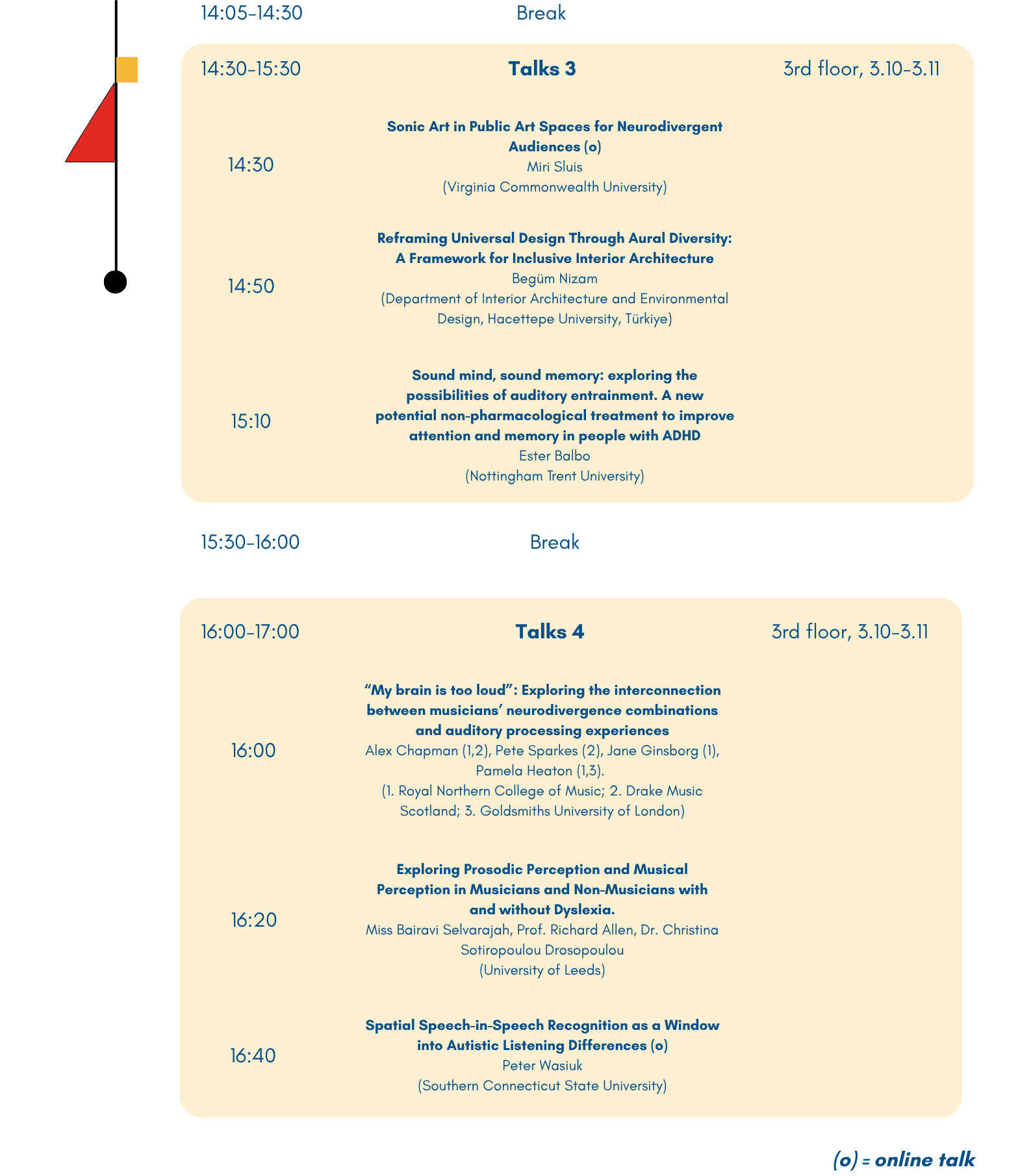
Talks 3
Sonic Art in Public Art Spaces for Neurodivergent Audiences
Miri Sluis
(Virginia Commonwealth University)
Public art spaces, such as galleries, are generally designed without care for the neurodivergent experience. Acoustics, light, and temperature create visceral sensations which are off-putting or even harmful for neurodivergent audiences. Mobilising the public art space as a research environment, this presentation explores how sound art can transform public art spaces to become more inclusive of neurodivergent audiences in ways that can also benefit neurotypical audiences. Qualitative research with neurodiverse and neurotypical visitors in and around immersive autistic aurally-led installations created by the artist-scholar presenter indicates that 88% to 90% of respondents experience a positive change in perception of a public art space as the result of immersion in specific sonic art pieces. The research demonstrates how focusing on the way sound art is presented in galleries and museums can lay a groundwork for public art spaces to become more inclusive for neurodivergent and neurotypical audiences alike. Neurodivergent ways of sensing, processing, and relating reveal hidden assumptions in and about public art environments. As a result, centering neurodivergent insight can shape and expand participation in public art spaces by emphasizing practical ways to examine and evolve the sensory spatial, sonic, and relational design of public art containers.
Reframing Universal Design Through Aural Diversity: A Framework for Inclusive Interior Architecture
Begüm Nizam
(Department of Interior Architecture and Environmental Design, Hacettepe University, Türkiye)
Interior architecture commonly addresses accessibility through mobility, vision, ergonomics, and regulatory compliance, while acoustic conditions are often reduced to standardised performance targets. This approach may overlook the fact that people hear, interpret, and respond to sound differently. Hearing loss, tinnitus, hyperacusis, neurodivergence, age, language, attention, and previous experience may all shape how an interior is perceived and used. This conceptual study examines how aural diversity can extend universal design in interior architecture. It aims to move acoustic accessibility beyond the binary distinction between “normal” and “impaired” hearing and to establish a design framework that recognises multiple listening profiles without treating any single profile as the default user. The proposed framework comprises four interconnected stages: identifying diverse listening profiles; mapping sound sources, spatial transitions, and potential auditory conflicts; evaluating environments through multiple use and listening scenarios; and developing design responses that provide acoustic choice, control, legibility, and opportunities for auditory refuge. It connects room-acoustic considerations, including background noise, reverberation, speech intelligibility, sound insulation, and spatial sound distribution, with interior design decisions such as zoning, circulation, material selection, visual communication, adaptable boundaries, and user-controlled environmental systems. Rather than prescribing one universally optimal acoustic condition, the framework supports the comparison of potentially conflicting needs across different users and activities. Aural diversity should therefore be treated as a fundamental dimension of inclusive interior architecture rather than as a specialist accommodation added after design completion. Integrating multiple listening profiles into early design decisions may produce environments that are more accessible, adaptable, and responsive to individual auditory experience. The framework offers a basis for future design studios, post-occupancy evaluations, and interdisciplinary research linking interior architecture, acoustics, universal design, and disability-informed design.
Sound mind, sound memory: exploring the possibilities of auditory entrainment. A new potential non-pharmacological treatment to improve attention and memory in people with ADHD
Ester Balbo
(Nottingham Trent University)
Auditory entrainment is a neurological phenomenon in which rhythmic sensory stimulation synchronises neural oscillations with an external rhythm. Recent studies have shown promising results for its application in improving cognitive function and emotional well-being. Based on this evidence, this project aims to investigate, using electrophysiology (EEG), eye-tracking and behavioural measures, the effects of auditory entrainment as a non-pharmacological treatment to improve memory and attention in people with ADHD. The hypothesis is that exposing people to rhythmic sounds for a short period (10 minutes) at a rate that corresponds to the brain’s natural beta frequency (14 Hz) will induce neural plasticity, boosting beta oscillations and simultaneously suppressing theta oscillations, normalising the altered theta-beta ratio observed in some individuals with ADHD. This project comprises three studies and will employ a randomised, counterbalanced within-subjects experimental trial design involving healthy adults with and without ADHD. The first study aimed to identify the optimal stimulation parameters for inducing auditory entrainment and improving memory and attention by comparing white noise, isochronic tones, binaural beats and monaural beats. Results from this study, conducted in adults without ADHD, showed that 14 Hz monaural beat stimulation produced the most consistent improvements in attention and memory, as measured by both accuracy and reaction time, across multiple tasks. Having established the optimal stimulation parameters, the second and third studies will investigate their effects in adults with ADHD using both generalised and personalised stimulation protocols. If proven to be effective in adults with ADHD, this approach could lead to a new type of low-cost non-pharmacological treatment that could be self-administered at home on an ADHD-friendly schedule, and that may also be beneficial for other forms of neurorehabilitation and neuroenhancement.
Talks 4
“My brain is too loud”: Exploring the interconnection between musicians’ neurodivergence combinations and auditory processing experiences
Alex Chapman (1,2), Pete Sparkes (2), Jane Ginsborg (1), Pamela Heaton (1,3).
(1. Royal Northern College of Music; 2. Drake Music Scotland; 3. Goldsmiths University of London)
Background and aims. Research suggests that musical engagement enhances aspects of wellbeing, social connectedness, and quality of life. However, those benefits appear to decrease when turning the passion into a profession. It is estimated that the prevalence of neurodivergence in music professions is higher than the general population’s 1 in 5. Neurodivergent musicians may report differences in sensory, perceptual, and cognitive experiences that impact them in everyday life and employment which may negatively affect their mental health. To date, few studies have explored neurodivergent musicians’ auditory experiences, including the link with co-occurring neurodivergence. The aim of this presentation is to provide an analysis of the interconnection between musicians’ neurodivergent identities and auditory processing experiences in live music settings, highlighting common and differing themes amongst the community. Methods. 141 neurodivergent musicians completed an exploratory survey enquiring into auditory processing, motivations and engagement, and reasonable adjustments in live music settings; this proceeded a consultancy phase for prioritising accessibility and community inclusion. Completion methods ranged from online to voice-recordings and interviews to provide accessible and strength-based alternatives. Analysis was undertaken using reflexive thematic analysis, with emphasis on commonalities and differences across and within neurodivergent identity combinations. Results. Findings revealed 17 neurodivergent identity combinations of which experiences were translated into three overarching themes: ‘navigating my sensory experiences’, ‘my neurodivergence consumes my emotions’, and ‘being absorbed by the music’. Subthemes were generated according to neurodivergent identity groups (e.g. dyslexia, AuDHD), capturing common experiences between musicians with similar neurodivergence profiles. Conclusions and Implications. Findings highlighted varying experiences which aligned with research on aspects of neurodivergence such as hyperfocus, sensory overwhelm, and sleep. More research is needed to understand neurodivergent musicians’ differing experiences and whether increased support from the industry could be beneficial for the community when working in live music settings.
Exploring Prosodic Perception and Musical Perception in Musicians and Non-Musicians with and without Dyslexia.
Miss Bairavi Selvarajah, Prof. Richard Allen, Dr. Christina Sotiropoulou Drosopoulou (University of Leeds)
Research on dyslexia indicates that phonological deficits extend to prosody, such as perceptual word-level stress sensitivity, which predicts reading skills. Given the cognitive overlap between language and music processing, studies have linked musicianship to better prosodic perception and reading abilities.
Additionally, music interventions have been explored for improving reading skills. However, the effectiveness of these interventions is debated, with some suggesting that musical perception may influence reading skills more than musical training alone. To fully understand how reading skills and musicality relate to prosodic perception, this study explores the main effects of dyslexia and musicianship on prosodic perception and their interaction in adults with and without dyslexia. We also examine the relationship between musical perception and prosodic perception, and how related variables (musical training, phonological processing, reading skill, and working memory) predict prosodic perception in these groups. Participants (N=75) were university students assigned to one of four groups: (1) Dyslexic Non Musicians, (2) Non Dyslexic Non Musicians, (3) Dyslexic Musicians, and (4) Non Dyslexic Musicians. They completed a battery of online tasks including the GOLD MSI musical training questionnaire, rapid automatised naming, spoonerism, reading accuracy and speed, forward and backward digit recall, the Musical Ear Test, and a word level prosodic perception task containing both correct and incorrect trials. As we are in the final stages of data collection and early analyses, we predict that individuals with dyslexia will show lower prosodic perception accuracy than non dyslexic peers. However, we anticipate that dyslexic musicians will outperform dyslexic non musicians, suggesting a potential compensatory benefit of musical training. Key findings will be presented at the conference, alongside an exploration of how each measured variable contributes to prosodic perception. These results aim to refine our understanding of prosody–music relationships in adults with and without dyslexia and to inform the development of more targeted music based interventions.
Spatial Speech-in-Speech Recognition as a Window into Autistic Listening Differences
Peter Wasiuk
(Southern Connecticut State University) wasiukp1@southernct.edu
Background: Everyday communication often occurs in environments with competing voices, reverberation, and other auditory challenges. Autistic adults frequently describe these settings as effortful, overwhelming, or inaccessible, even when standard clinical hearing thresholds fall within the typical range. These experiences highlight the need to understand listening beyond a “normal-versus-impaired” model. Aims: This study examined how autistic and non-autistic young adults use spatial cues to recognize speech in competing-speech environments, and whether laboratory measures relate to self-reported social communication experiences and listening fatigue. Methods: Participants were 25 autistic and 30 non-autistic young adults with clinically normal hearing thresholds. Speech reception thresholds (SRTs) were measured adaptively using meaningful target sentences with two-talker speech maskers. Three spatial conditions were tested: colocated target and maskers, perceived spatial separation using an interaural timing cue, and true spatial separation with target speech from the front and maskers from the side.
Spatial release from masking was calculated as the improvement in SRT from colocated listening to each separation condition. Autistic participants completed self-report measures of social communication experiences and listening fatigue. Results: Spatial cues supported speech-in-speech recognition for both groups, with the strongest benefit in true spatial separation. However, autistic participants showed higher SRTs than non-autistic peers across conditions, with the largest group differences when spatial cues were available. Autistic participants also showed reduced spatial release from masking, especially in perceived separation. Within the autistic group, greater self-perceived social communication differences were associated with poorer speech-in-speech recognition in colocated and perceived separation, and listening fatigue was associated with poorer recognition during colocated listening. Conclusion and Implications: Spatial cues improve access to target speech for autistic young adults, but may not provide the same degree of benefit observed for non-autistic peers. These findings highlight spatial listening as one contributor to autistic listening differences and underscore the importance of creating inclusive communication environments for diverse listening needs.
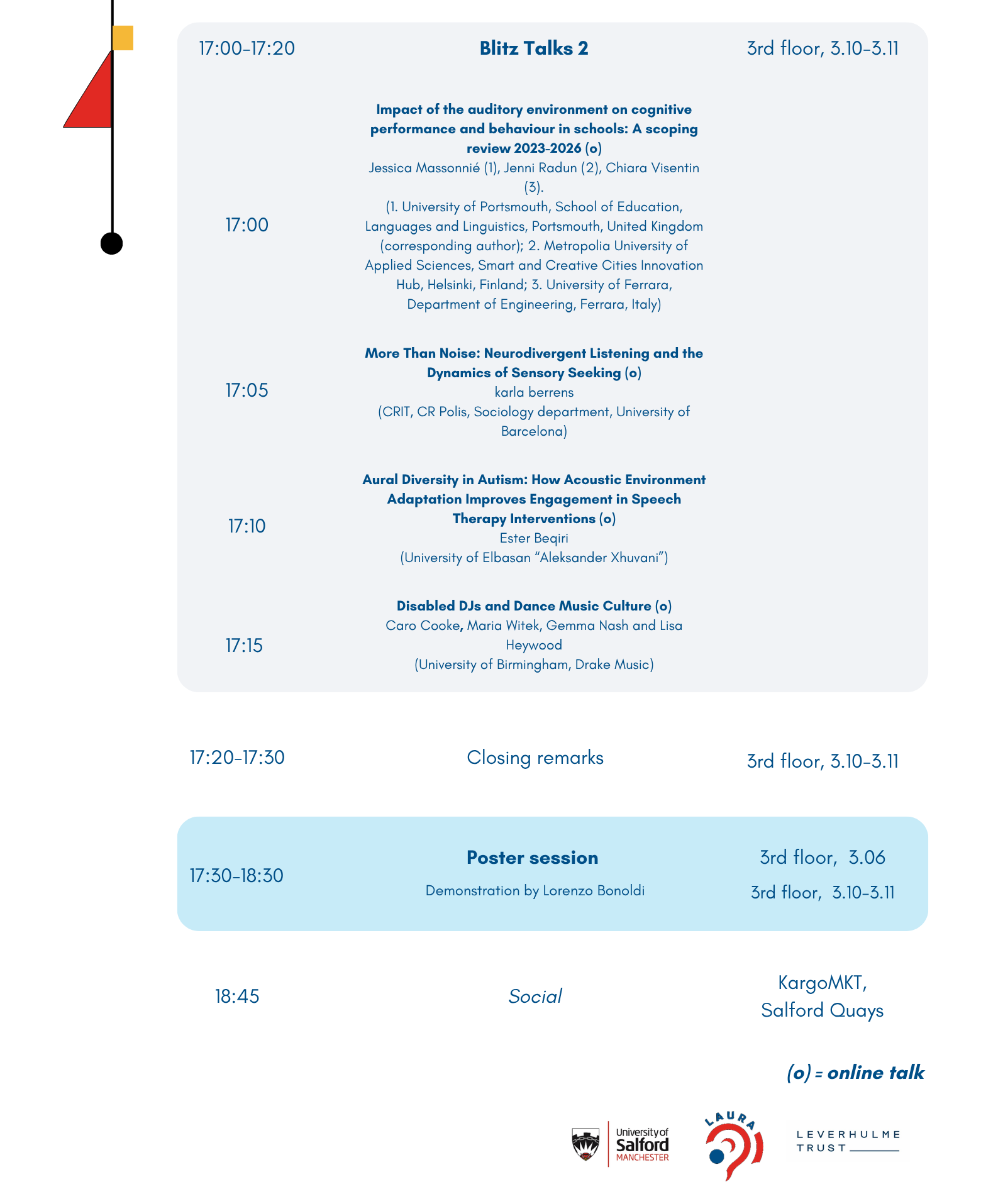
Blitz Talks 2
Impact of the auditory environment on cognitive performance and behaviour in schools: A scoping review 2023-2026
Jessica Massonnié (1), Jenni Radun (2), Chiara Visentin (3)
((1) University of Portsmouth, School of Education, Languages and Linguistics, Portsmouth, United Kingdom (corresponding author); (2) Metropolia University of Applied Sciences, Smart and Creative Cities Innovation Hub, Helsinki, Finland; (3) University of Ferrara, Department of Engineering, Ferrara, Italy)
Background. Schools are full of life and full of sounds. These become noises when they are unwanted, harmful, and/or impact performance. Reviews studying the impact of sounds on children’s performance and behaviour published until 2024 called for more research involving neurodevelopmentally diverse children. Aims. We present an updated review of the field. Methods. Following the PRISMA scoping review protocol, four databases were searched (MEDLINE Complete, PsychInfo, Scopus, Web of Science).
Selected articles had to: (1) be peer-reviewed journal articles published in English; (2) include at least one objective sound measurement; (3) present at least one experimental comparison which varied the stimulus; (4) report at least one quantitative or qualitative measure of cognitive performance; (5) Involve participants under 18. Articles that only reported neurophysiological measures, focused on cochlear implants, or speech intelligibility/listening comprehension were excluded. Two reviewers independently: screened abstracts; screened the full-text of eligible papers; charted the data. Decisions were aligned for 99.5% of the articles. Discrepancies were resolved through consensus. Results. 886 papers were retrieved (812 after removing duplicates). Following abstract screening, 67 full texts were checked. Twenty papers met the inclusion criteria. Participants, sound conditions, experimental context, performance measures, study design, results were charted. Conclusions. Steady-state sounds (ventilation, white noise) can have a positive impact on performance, an effect attributed to arousal (2 studies). Reading performance was negatively affected by semantic sounds (3 studies). Irrelevant sounds were more likely to negatively impact memory for short-term serial tasks or tasks with high cognitive load (5 studies). Most studies on acute sound exposure excluded participants with neurodevelopmental conditions, learning disabilities or language delays. Five studies on chronic exposure to transportation sounds which included neurodevelopmentally diverse children used extensive cognitive test batteries as outcome variables.
More Than Noise: Neurodivergent Listening and the Dynamics of Sensory Seeking
karla berrens
(CRIT, CR Polis, Sociology department, University of Barcelona)
For nearly two decades, my research has explored the relationship between sound, space and the making of place. From an initial focus on soundscape and place-making, my work has progressively examined the interplay between ambiances, spatial functionality and everyday experience. More recently, I have investigated the interconnections between sound, nociception, collective practices such as correfocs, and senses of belonging. Building on this trajectory, this paper develops a reflexive analysis of aurality through the lens of neurodivergence, focusing in particular on autism and its sensory dimensions. Autistic perception is often characterised by heightened sensory sensitivity and a different neurological processing of stimuli. Rather than pruning neuronal connections in adolescence in the same way as neurotypical brains, autistic brains may retain a greater number of connections, resulting in a dense and continuous flow of sensory information. When coupled with a perceptual system attuned to even minimal acoustic variation, this can lead to sensory overload and, consequently, to strategies of sensory avoidance.
However, this paper argues that this is only part of the picture. Alongside sensory avoidance, many autistic individuals engage in forms of sensory seeking, actively pursuing specific auditory stimuli. This dual dynamic challenges simplified understandings of auditory experience and calls for a more nuanced conceptualisation of aurality. By bringing together soundscape research, spatial analysis and neurodivergence, this paper contributes to ongoing discussions on aural diversity by foregrounding the relationship between embodied auditory perception, spatial practices and differentiated modes of listening. It ultimately proposes a reflexive framework for understanding how sensory seeking practices may shape both individual experiences and collective engagements with sound.
Aural Diversity in Autism: How Acoustic Environment Adaptation Improves Engagement in Speech Therapy Interventions
Ester Beqiri
(University of Elbasan “Aleksander Xhuvani”) esterbeqiri44@gmail.com
Introduction: Many children with Autism Spectrum Disordres (ASD) experince aural diversity through sensory hyper- reactivity to sounds. Unpredictable enviromental noises or loud background frequencies can couse severe emotional stress and sensory overload, making it difficult for them to engage during speech therapy sessions. Objective: This paper aims to analyze how adapting the acoustic environment can succsessfully reduce sensory anxiety and improve the child’s active participation and engagement during speech therapy. Methodology: This study is based on a rivew of contempary literature regarding speech therapy interventios for sound sensitivity. Databased such as PubMed were examinated to analyse cases of improvement through acoustic modifications and noise. Results: The findings demonstrate that standars speech therapy exercises are significantly more effective when therapy exercises are significantly more effective when the acoustic environment is cntrolled. Simple adaptions, such as minimizing background echoes and using sound-absorbing materials , lower anxiety. When the auditory setting is calm, children show higher focus, intercact better with speech therapist ,and acquire skills faster. Conclusions: Adapting the acoustic environment s a foundmental, requirement, not an option, in speech- language pathology for auistic individuals. Speech therapy frameworks must be tailored to respect the unique sensory reality of each child to maximize rehabilititation outcomes and improve their daily quality of life Keywords: Autism; Acoustic Environment ; Speech Therapy ; Sound Sensitivity ; Speech Therapist.
Disabled DJs and Dance Music Culture
Caro Cooke, Maria Witek, Gemma Nash and Lisa Heywood (University of Birmingham, Drake Music) c.cooke@bham.ac.uk
In this presentation, we take a participatory approach to the study of Disabled DJs’ experiences of navigating dance music culture. In collaboration with Drake Music – a leading UK charity on disability, music, and technology – we report on empirical research conducted with Disabled DJs, including media diaries and interviews, and consider our results in relation to dance music and disability scholarship. We show that being Disabled can both enrich and pose barriers to DJing, including experiences of hyperempathy for the dancefloor, conflicted feelings about dancing, and destabilising notions of DJ authenticity. DJing offers a role through which Disabled people can participate in the social and creative practices afforded by dance music culture, away from the crowd and through the music. In this way, this research challenges key essentialisms in dance music scholarship and disability research, including the centrality of dance and body movement and the social deficits of neurodivergence.
Posters
1. Speech in Noise Perception and Perceptual Capacity in Autistic Individuals
Paula H. Schneider, Bill Davies, Samantha Gregory
(University of Salford, Leverhulme Trust Aural Diversity Doctoral Research Hub (LAURA)) p.h.schneider@edu.salford.ac.uk
Autistic individuals have been shown to exhibit a higher auditory perceptual capacity than non-autistic (allistic) individuals, perceiving a greater amount of simultaneous auditory input. The present study aims to replicate these previous findings and to investigate whether individual differences in auditory perceptual capacity are associated with speech-in-noise perception. Many autistic people report pronounced difficulties understanding speech in noisy environments, which can substantially impact everyday functioning and social participation. However, the underlying mechanisms contributing to these difficulties are not yet fully understood, and no prior research has directly examined the relationship between auditory perceptual capacity and speech-in-noise perception in autism. An in-person auditory behavioural experiment will be conducted with autistic and allistic participants. Auditory perceptual capacity will be assessed by measuring the maximum number of distinct sound sources (animal sounds) that can be presented simultaneously while participants are still able to detect a predefined target sound. Speech-in-noise perception will be measured using a digit-in-noise task, in which participants listen to digit triplets while multi-talker babble noise is presented at varying loudness levels. In addition, participants’ sensory sensitivity and auditory working memory capacity will be assessed. This study seeks to provide further insight into differences in auditory perceptual capacity between autistic and allistic individuals and their potential implications for real-world listening situations, such as social interaction in noisy environments.
More broadly, the findings may contribute to a shift away from deficit-based accounts of autism toward a mismatch perspective that emphasises interactions between individuals and their environments.
2. Listening Across Difference: Testing the Double Empathy Problem in Voice Perception
Safiye Sena Dokmeci, Samantha Gregory, Bill Davies, Rebecca Vos
(University of Salford, Leverhulme Trust Aural Diversity Doctoral Research Hub (LAURA)) s.s.dokmeci@edu.salford.ac.uk
Voice plays an important role in social communication and social perception. Previous research suggests that autistic individuals may differ from non-autistic individuals in terms of prosody, vocal production and voice perception. However, voice perception in autism still remains relatively understudied compared to facial expressions and language-based communication. In addition, many previous studies approached autistic communication mainly from a deficit-based perspective and evaluated autistic communication according to neurotypical social expectations. The current project examines whether autistic and non-autistic individuals perceive voices from their own neurotype differently. The study is based on the Double Empathy Problem framework, which suggests that communication difficulties between autistic and non-autistic individuals may emerge because of differences in communication styles rather than one-sided social deficits. From this perspective, communication difficulties may be relational and mutual rather than caused only by autistic individuals. This project focuses on different aspects of voice perception through four studies. These studies examine memory recall, emotion recognition and acoustic-prosodic entrainment across neurotypes, as well as the aesthetic evaluation of singing voices. Voice recordings will be collected from autistic and non-autistic speakers in an acoustically controlled environment. The project additionally examines how acoustic-prosodic features such as pitch, loudness and speech rhythm may influence social evaluations and communication. It is expected that participants may show more positive evaluations, stronger rapport and better recognition performance when listening to speakers from their own neurotype. Same-neurotype interactions may also show stronger vocal coordination and more positive communication outcomes compared to mixed-neurotype interactions. The findings may contribute to a more relational understanding of autistic communication and voice perception.
3. Aural Diversity In Soundscape Perception: Comparing ADHD, Autistic, And Neurotypical Listeners On The ISO 12913 Circumplex
Paul Andrew Magrath
(Acoustics Research Centre, University of Salford, Salford, UK Leverhulme Trust Aural Diversity Doctoral Research Hub (LAURA))
Soundscape research generally assumes a uniform listener, yet people differ in how they process sound. This study tested whether neurotype shapes soundscape perception by comparing ADHD, Autistic and Neurotypical listeners (n = 30 per group) on ten field-recorded soundscapes, delivered online as binaural stereo and rated on the ISO 12913-2 perceptual circumplex through a calibrated interactive task. Across the pooled soundscapes, ADHD listeners rated the soundscapes as significantly less eventful than Neurotypical listeners (p = 0.043), while pleasantness was unaffected. The ADHD effect was small but consistent, appearing in the same direction in eight of the ten soundscapes rather than being driven by any single soundscape. ADHD listeners also showed a non-significant trend towards more extreme responding. Contrary to expectation, the Autistic group closely resembled the Neurotypical group on every measure (SPI = 92.4). The findings give empirical support to an aural diversity framework for soundscape research, while showing that neurodivergent groups differ from one another and should not be treated as a single category.
4. Auralplasticity: Unmasking the Neurodivergent Voice
Ingrid Plum
(University of Salford, Leverhulme Trust Aural Diversity Doctoral Research Hub (LAURA))
Background This project explores the intersection of disciplines between auraldiversity, participatory choral composition and emergent technologies within a group of neurodivergent singers with heightened sensitivity to sound. To create composition by/for neurodivergent performers, we must find new strategies for participatory composition, with more immediate interaction and bilateral collaboration. The more inclusive choral research that extends to hearing difficulties, suggests the next step in research is to develop embodied modes of communication to extend multivocality to be more inclusive (Meizel, 2020). ‘Emergent technologies’ here refers to embodied sensory MIDI controllers which respond to the relationship between body and space, through touch and proprioception. Aims By intersecting accessible design principles (Kelly, 2020) with research into the neurodivergent experience (Danon, 2025), we can develop a neurodivergent-inclusive design (Drake Music, 2023). This project is developing new strategies in composition through inclusive mapping and communication of the neurodivergent performer experience using embodied musical interaction (Tanaka, 2019). Main Contribution An echo of neuroplasticity, ‘Auralplasticity’ is used here to identify the new compositional strategies that can be formed to organize the knowledge or experiences of neurodivergent performers and audience, building on the themes in ‘Primacy of the Ear’ (Drever, 2019). We can think of ‘Auralplasticity’ as an auditory feedback loop of the embodied practice and communication pathways in the performance space. For the neurodivergent singer, a gap exists within the performance environment designed for neurotypical performers, which expects a mode of communication that may not be available to someone experiencing sensory overwhelm due to hyperacusis. This project proposes to create an alternate path of communication via embodied sensory MIDI controllers. Implications Auraldivergent singers may have more access to flow state and detailed listening (Davies, 2023). This, in turn, can benefit the neurodivergent audience, as emancipatory research creates a more inclusive sonic environment (Chown et al., 2017).
5. Integrating Loudness Discomfort Levels into Equal Loudness Level Contours to Derive how Noise Sensitive Autistic Adults Perceive Sound
Steven Mitchell
(University of Salford – Prof Antonio J. Torija Martinez & Dr. Robert Bendall)
Autistic people are known to have sensory sensitivities, one of these being noise sensitivity. Everyday noise can become overwhelming and lead to these individuals avoiding busy environments which, in turn, reduces the inclusion of this group in society. It has been found that everybody hears differently. This is called Aural Diversity. Noise sensitive individuals are not currently considered within government policy, guidance, British Standards, ISO’s, Codes of Practice or assessment methodology for environmental noise. Noise sensitivity research in autistic individuals does not currently meet the standard compared to “normal” hearing people. Equal loudness level contours are a necessity for acoustic consultancy to derive weighting levels, however, the differences in perception of frequency at varying levels, and the impact of noise and how this changes an autistic person’s physiological state have not been assessed. These studies could be a catalyst for future studies to better understand the impact of noise on noise sensitive autistic people which could lead to safer and more inclusive environments. Data collection remains in progress, however, the results obtained and analyzed so far will be presented.
6. Hearing diversity across objective, behavioural, and experiential measures
Natasha Winge, Christos Chousidis, Russell Mason
(Institute of Sound Recording, University of Surrey) n.winge@surrey.ac.uk
People differ widely in how they hear and respond to sound, even when standard hearing tests suggest broadly similar hearing sensitivity. Understanding this diversity requires looking beyond a single measure of hearing. This study explored individual differences across objective inner-ear measurements, behavioural listening tasks, audiometric thresholds, and listener background. Forty participants completed two test sessions. Pure-tone audiometry was used to characterise hearing sensitivity. Participants also completed behavioural tasks measuring intensity discrimination and frequency discrimination at several frequencies. In addition, distortion product otoacoustic emissions (DPOAEs) were measured from both ears. Each DPOAE measurement was repeated three times per session across 11 frequencies, allowing both within-session and between-session variability to be examined. Participant factors including musical training, audio experience, tinnitus, and neurodivergence were also recorded. Preliminary analyses suggest that hearing diversity was not explained by one measure alone. DPOAE levels showed relatively little systematic change between sessions, but individual session-to-session differences were larger than repeat variability within a single session. This indicates that objective measures of cochlear function can be stable within a visit while still varying meaningfully across visits. Relationships between DPOAE level and behavioural discrimination thresholds were also explored, with musical training showing clearer associations with perceptual performance, wand greater musical training linked to better intensity and frequency discrimination. Tinnitus was also associated with differences in frequency discrimination in exploratory analyses, although this may overlap with listening experience. These findings support a multi-dimensional view of hearing diversity.
Objective ear measures, audiometric thresholds, perceptual performance, and lived listening history each capture different aspects of auditory function. For aural diversity research, this highlights the importance of interpreting physiological measures alongside behavioural and experiential data, rather than treating any single measure as a complete description of an individual’s hearing.
7. Dyslexic Imagination – Dyslexic Listening
John L. Drever
(University of Cambridge)
How has working as a dyslexic composer, sonic artist, and music lecturer for over 30 years shaped my evolving practice? This paper adopts an autoethnographic methodology to examine a sustained creative and pedagogical practice developed within, against, and beyond neurotypical and auraltypical paradigms of music and sound-making. Grounded in lived experience, it interrogates how dyslexia has shaped both the constraints and generative possibilities of this practice. It traces how dyslexia has at times constrained my work, particularly through the lack of automaticity in reading and writing conventional music notation, and the recurrent necessity of relearning music theory and technical processes, often as if encountered anew. Core skills that are typically fluent and unconscious are instead slowed, with increasing cognitive load through reliance on conscious compensatory strategies (Nicolson & Fawcett, 1989). These draw on higher-level cognitive resources, including semantic knowledge, contextual inference and auditory memory. Such experiences are further intensified by stress and the ongoing labour of masking, which dominant disciplinary frameworks frequently construct as deficiency. 1. However, this paper foregrounds the development of intuitive, playful, and direct sonorous approaches that eschew conventional notation, emerging from these conditions. It situates these within the concept of auraldiversity (Drever, 2015; 2019), where sound, memory, space, and structure are processed differently, and deviation from normative musical literacy and audition becomes generative. Drawing on work that foregrounds dyslexic imagination (Griggs, 2024), it examines how these experiences give rise to alternative compositional, pedagogical, aural, spatial, improvisational, and technological strategies. From this perspective, dyslexia is not positioned solely as a limitation but as a productive force that unsettles normative assumptions about literacy, memory, and musical knowledge. Ultimately, the presentation proposes that dyslexic listening is not merely adaptive but generative, offering critical insights into more inclusive and plural approaches to music and sound-making.
8. Listening to Derek Jarman: Blindness, Sonic Dwelling and Aural Diversity at Prospect Cottage
Chrystal Cherniwchan (University of Salford) C.Cherniwchan@salford.ac.uk
Derek Jarman’s later work has frequently been discussed through the lenses of illness, AIDS, advocacy, landscape, queer theory and visual culture. Yet comparatively little attention has been paid to listening as a central creative practice within his work or to the role of Prospect Cottage as a sonic environment that shaped his artistic imagination. This project argues that Jarman’s experience of blindness offers an opportunity not simply to reconsider his later practice, but to rethink how artistic knowledge emerges through listening. I am proposing that aural diversity acts as a framework for understanding listening as embodied, relational, and environmentally situated. Rather than treating blindness as a loss of vision, this work examines how changing sensory experience may have transformed Jarman’s relationship with sound, place and artistic practice. Prospect Cottage is approached not simply as Jarman’s home, but as a living acoustic archive that is a domestic space where the sounds of wind, sea, weather, wildlife and the nearby nuclear power station exist in both the interior and exterior, that influenced his writing, gardening and filmmaking. The research methodologies are a combination of aural and sensory ethnography, site-responsive field recording, analogue filmmaking and phenomenological enquiry, investigating how listening mediates relationships between body, environment and creative practice. My aim is to position Jarman as a significant yet underexplored figure within sound studies, while contributing to wider debates surrounding disability, more-than-human environments and sensory differences. By reframing Jarman as an artist of listening, this research extends beyond a single case study to ask broader questions about how sound shapes creative practice, how environments participate in artistic production, and how recognising aural diversity might transform our understanding of perception, cultural heritage, and inclusive forms of knowledge.
9. Improving music for those with hearing difference: a participatory approach using professional sound engineers
Lorenzo Bonoldi
(University of Salford, Leverhulme Trust Aural Diversity Doctoral Research Hub (LAURA))
This study investigates how audiometric diversity shapes professional music mixing practices, challenging the prevailing assumption that audio production is optimised for a single, normal-hearing listener. Using a participatory, mixed-methods approach, the study engages hearing-diverse audio engineers as co-investigators to examine how perceptual differences influence technical decision-making in real-world mixing contexts. The research integrates semi-structured interviews, audiometric assessment, collaborative remix tasks, and signal-based audio analysis. A descriptor–metric mapping framework (DMMF) is developed to link subjective perceptual descriptors—such as clarity, brightness, density, and openness—to measurable audio features, including spectral centroid, low-mid energy (250–500 Hz), crest factor, integrated loudness (LUFS), and stereo width. This enables systematic comparison between perceptual experience and objective signal characteristics. Across participants, findings reveal consistent adaptive mixing strategies grounded in individual auditory profiles. Contrary to conventional industry practice, perceptual improvements are not achieved through increased loudness, expanded stereo width, or enhanced high-frequency content. Instead, clarity and listening comfort emerge through redistribution of spectral energy, reduction of low-mid masking, preservation, or enhancement of dynamic contrast, and controlled spatial organisation. In several cases, hearing-optimised mixes exhibit lower loudness and narrower stereo images while achieving greater perceptual clarity and stability. The study also highlights the role of perceptually adaptive tools in supporting diverse users. Visual and interactive audio interfaces act as perceptual supports, translating complex signal features into accessible feedback and enabling engineers to identify masking, spectral balance, dynamics, and spatial distribution that may not be fully audible. By supporting user-driven adjustment and making mix parameters perceptually transparent, such tools augment listening and enable more inclusive, perception-aware creative workflows. The study reframes hearing-diverse engineers as perceptual experts and positions mix quality as relational and context-dependent. It contributes an inclusive, perception-led framework for audio production, with implications for studio practice, education, and the design of accessible creative workflows. Future work extends this research into an HCI context through the co-design and evaluation of perceptually adaptive mixing interfaces. Through controlled listening studies with both normal-hearing and hearing-impaired participants, the project will investigate how interactive tools can improve clarity, reduce listening effort, and support personalised control by making spectral, dynamic, and spatial features more perceptually transparent and adjustable.
10. Deaf and Hard of Hearing Perspectives on Sonic Experiences and Museums
Tonya North
(University of Westminster)
Background: There is a common misconception that sound is irrelevant to deaf and hard of hearing people. Within museums, this assumption is reflected in accessibility approaches that prioritize vision as the primary mode to engage with collections. This overlooks the diverse ways that deaf and hard of hearing adults perceive, interpret, and engage with sound. As a result, very little is understood about how deaf and hard of hearing people’s relationship with sound shapes their engagement with museum environments.
Aims : This study aims to explore the diverse ways deaf and hard of hearing adults relate to and make meaning from sound and how these relationships shape their perceptions and experiences of museums. Methods : Semi-structured interviews explore participants’ relationships with sound, their experiences of museums, and how these shape memories, emotions, and engagement. Participants are being recruited from both the US and the UK and include people who use signed languages, spoken language, or both. Data will be analysed using thematic analysis. Results: Findings will identify themes relating to participants’ relationship with sound, the meanings they attribute to different sonic environments, and how these experiences shape perceptions of and engagement with museum spaces. Conclusion and Implications: This research will provide a deeper understanding of how deaf and hard of hearing people relate to sound and how these relationships shape experiences of museum environments. These findings will inform my future research into exploring deaf-led interpretation of immersive sound experiences through a co-creation workshop with the Science Museum Group.
11. Living in the Grey Area: Sensory Change and Access to Care
Rachel Thomsen
(Advanced Care Research Centre Academy at the University of Edinburgh) rachel.thomsen@ed.ac.uk
Background Communication depends on our ability to see, hear, and speak; when these senses change, they have far-reaching effects that go beyond health and permeate every day. Although hearing and vision loss are common, few people seek support in the early stages, leaving sensory needs often seen, but not met. Through an interdisciplinary approach, this PhD study addresses this ” grey area ” to explore why recognising change does not necessarily lead to accessing care. Aims The study aims to understand how changes in hearing and/or vision shape everyday communication and care experiences, and how systems of care can better recognise and respond to these changes across social and structural contexts. Methods Guided by Experience Based Co-Design and a Lived Experience Advisory Group, this qualitative project uses walking interviews with adults in Scotland’ s Central Belt who self-report changes to hearing (n=10), vision (n=10), and both senses (n=10). Later, co-design workshops with people living with sensory change, carers, and professionals will explore perceptions of a proposed data-sharing tool, the Evergreen Passport, which aims to coordinate disjointed services. Results Preliminary literature review findings evidence how age-related sensory loss is a significant public health concern, linked to increased risk of poorer cognitive and functional outcomes. However, less is known about how people perceive the onset of hearing or vision changes, adjust their communication practices, and negotiate whether, and when, to seek support. This gap necessitates a qualitative, lived-experience-informed approach. Conclusion This PhD first asks what it feels like to live through gradual sensory change, before co-producing solutions to create a better framework for designing support that is informed by lived experience. Implications This study will assist in identifying the critical points where change can occur and lay the foundational principles for redesigning sensory care pathways that better reflect lived experience of sensory change as you age.
12. Probing the neural bases of sound processing for ASMR and subclinical misophonia
Ilana Harris1, Sarah Liu1, Mathilde Bauer2, Anushree Anandani3, Marcus Pearce4, Sophie Scott1
(1. University College London 2. The University of Salford 3. New York University 4. Queen Mary University of London)
ASMR is a multisensory phenomenon where certain proximal human-made sounds, including whispering and tapping, are pleasantly perceived, and can evoke tingling sensations and induce relaxation. In contrast, misophonia is defined as the “hatred of sound” and refers to extremely aversive reactions (irritation, anger, disgust) to certain human-made sounds (e.g., breathing or mouth sounds). Both phenomena have been found to occur prevalently in the general population (i.e., 49.1% of university students experience misophonic symptoms; 89% of the general population experience ASMR for at least one sound). We conducted a passive-listening fMRI study (34 participants) to investigate the neural bases of ASMR and misophonia in the general population. We expected that ASMR-inducing sounds would elicit activity in regions that support the processing of musical reward (i.e., auditory, insular, frontal, and striatal regions), and misophonia-inducing sounds would elicit activity in regions previously identified in clinical misophonic populations (i.e., auditory and insular regions). Clusters in the bilateral superior temporal gyrus (STG) and right superior temporal pole were found to be more active during the playback of ASMR vs. misophonic sounds. Clusters in the bilateral STG (near Heschl’s gyrus) and left insula were found to be more active during the playback of misophonic vs. ASMR sounds. In contrast to our expectations, ASMR sound processing does not seem to rely on a distributed frontostriatal reward network and may thus be neurally distinct from musical reward processing. Misophonic sounds, however, do seem to rely on auditory and insular cortical processing in regions similar to those found in clinical populations; this suggests that subclinical misophonia may share some neural signatures with clinical misophonia. Future work should investigate how the neural circuitry of misophonic sound processing varies across levels of symptom severity (i.e., probing when and how salience networks become relevant).
D1) Psychometrics and Sound-Response Profiles of Decreased Sound Tolerance: A Research Plan
Mathilde Bauer, Robert Bendall, Duncan Williams
(University of Salford, Leverhulme Trust Aural Diversity Doctoral Research Hub (LAURA)) m.b.bauer@edu.salford.ac.uk
Decreased Sound Tolerance conditions include misophonia and hyperacusis. Emerging research suggests that some people may experience hyperacusis and misophonia concurrently. However, previous misophonia studies have excluded hyperacusis because the overlap between these conditions is unclear. Commonly used measures of Decreased Sound Tolerance have been shown to correlate, indicating a commonality. This has prevented researchers from being able to confidently use these measures to assess hyperacusis and misophonia simultaneously and as separate constructs. This study replicates previous misophonia research in psychometrics and sound-response profiles, extending those methods to hyperacusis samples. Group membership (Individuals with Hyperacusis, Misophonics, controls, or those who report both conditions simultaneously) will be determined using self-report measures as well as clinical diagnosis of hyperacusis. Correlations in commonly used psychometrics (e.g., Sussex Misophonia Scale; Hyperacusis Questionnaire) will be assessed. A sound-response profile will be extracted to assess specificity of sounds and responses in Decreased Sound Tolerance, using machine learning classifiers to identify sound-response patterns predicting group membership. It is expected that misophonia will be associated with a characteristic reaction which is exacerbated in specific sounds, and that hyperacusis may rather largely be concerned with specific descriptors (e.g., loudness, pain) across sounds. Additionally, acoustic feature extractions, spanning beyond those previously suggested to be indicative of unpleasantness, are hypothesised to support that hyperacusis be more acoustically driven than misophonia. The latter would therefore rather relate to semantic and affective properties of sounds, confirming prior consensus. This research aims to clarify Decreased Sound Tolerance experience, facilitating and improving efficacy of diagnosis using self-report measures. This will ultimately allow researchers to confidently assess both conditions simultaneously. Methods and results will be made freely available via the OSF. Further studies will analyse the impact of context and emotion regulation strategies in Decreased Sound Tolerance, using the diagnostics identified in the current study.
D2) The Role of Sound on Everyday Stress and Well-being in Autism- a focus on hyperacusis
Oluwatosin Dawodu, Dr. Bruno Fazenda, Dr. Victoria McQuillan (University of Salford)
Hyperacusis, a reduced tolerance to everyday sounds is a significant auditory sensitivity among autistic adults, with substantial implications for participation, wellbeing, and quality of life. Autistic adults are disproportionately affected, with prevalence rates considerably higher than those observed in the general population, yet the condition remains under-recognised within both clinical and built environment research. Despite this, current understanding of how everyday acoustic environments shape hyperacusis-related distress in this group remains limited. Existing research has largely relied on retrospective questionnaires, offering limited insight into the dynamic, context-dependent, and environmentally situated nature of auditory experience. Critically, no study has thoroughly examined hyperacusis across domestic, workplace, and public environments simultaneously, leaving a significant gap in ecological understanding. This study investigates the relationship between real-world acoustic exposure and hyperacusis-related distress in autistic adults, with particular emphasis on identifying the acoustic characteristics and environmental settings that contribute to sensory overload. A sequential mixed-methods design is employed, integrating a purpose-designed questionnaire informed by validated instruments, semi-structured interviews analysed using Interpretative Phenomenological Analysis, and controlled laboratory-based acoustic observations using calibrated equipment. This approach combines qualitative lived experience data with experimentally controlled behavioural and perceptual responses to sound, enabling comprehensive investigation of person-environment interactions across three distinct soundscapes. The study examines how acoustic parameters including sound level, temporal variability, and predictability alongside contextual factors such as activity and social settings, influence auditory distress and participation. The role of coping strategies, including avoidance behaviours and use of hearing protection in modifying patterns of acoustic exposure over time is also explored. Particular attention is given to how neuronormative acoustic design contributes to barriers experienced by autistic adults in everyday environments. Findings are expected to inform more ecologically valid assessment methods, evidence-based support strategies, and acoustically inclusive design principles for homes, workplaces, and public spaces.
Keywords: hyperacusis; autism; acoustic environments; soundscapes; acoustic accessibility; neuronormativity
D3) Neighbour Noise and Noise Sensitivity
Rebecca Hutt, Bill Davies, Graeme Sherriff
(Sustainable Sound Futures Centre for Doctoral Training, University of Salford) r.hutt1@edu.salford.ac.uk
I am a first year PhD student researching Neighbour Noise (NN) i.e. the sound you sometimes hear when you’re at home, coming from others inside their home(s). To help me identify the common sources of NN, I am running an online questionnaire which is open to all adults who have lived in the UK for at least 6 months. For each NN source that is heard, the respondent is asked how it makes them feel and what activity/ies it affects. They are also asked questions adapted from the shortened form of Weinstein’s Noise Sensitivity Scale to capture a unidimensional self-reported measure of sensitivity to noise. My poster will present preliminary results, examining which sources of NN are affecting noise-sensitive respondents and how it makes them feel compared to less noise-sensitive respondents.
D4) Everyday music listening, wellbeing, and hearing loss – consultation with a lived experience advisory panel to develop research questions for future studies
Addie Beckwith, Duncan Williams, Robert Bendall
(University of Salford, Leverhulme Trust Aural Diversity Doctoral Research Hub (LAURA))
Everyday music listening (EML) – listening to your preferred choice of music, how, when and where you want to hear it – is associated with increased wellbeing and quality of life, and decreased depression and anxiety. However, research in this area typically excludes people with hearing loss from taking part, or does not record participants’ hearing health. Since an estimated 1/3 of the UK population have some experience of hearing loss, excluding them from research means that findings cannot be generalised to the wider population. The researcher is undertaking a mixed methods PhD programme to address this gap in knowledge. A scoping literature review and cross-sectional survey have already been undertaken. Public involvement, engagement and consultation (PPIE) are an important part of the research process, particularly within health research. The researcher therefore facilitated an advisory panel event to share findings of studies undertaken to date and to consult on future planned studies. Fifteen adults with experience of hearing loss (± deaf / tinnitus) attended the event in June 2026. The researcher’s background and experience of hearing loss was disclosed to the participants at the beginning of the event. Panel members were invited to share their views and opinions on experiences of taking part in research; experiences of listening to music and how hearing loss impacts this; and hearing loss and wellbeing. A summary of feedback received will be shared with everyone who attended. The themes and issues raised will be used by the researcher to develop the questions for a focus group interview study. As research in the field of aural diversity increases, it is important that this research aligns with the priorities and needs of the communities being studied. We therefore call upon researchers to include consultation with people with lived experience as part of the research process.